With great power, come great responsibility
AI Ethics
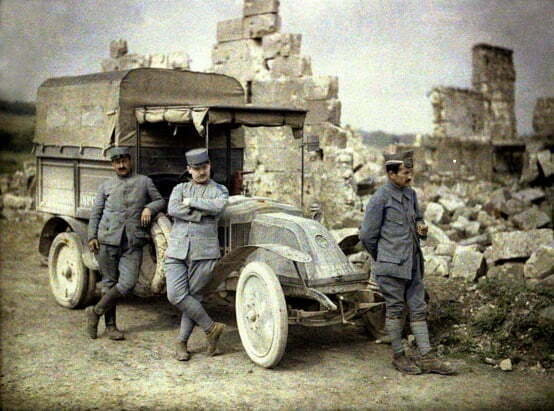
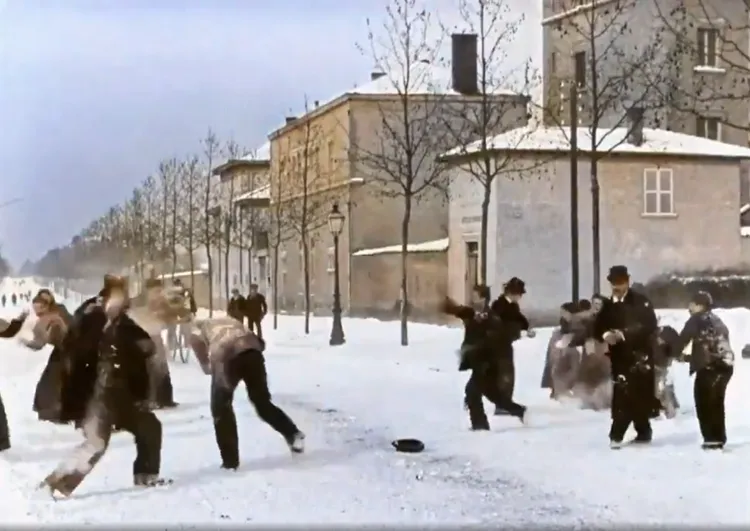
Ethical questions on the automated tools for upscaling and colorization of historical content.

I recently took position in Likedin post (here) about the Ethical issues raised by the use off AI tools (like DeOldify and Neural Love) for upscaling and colorization of historical content. As the ethical issues raised there seemed interesting I think its wise to share it here as well.
The upscaling technologies are truly amazing. That being say we need to really be careful on how to use it, as in the society of pictures we’re currently living in, it can induce a false representation of history.
We currently live in a society governed and immersed in a permanent flow of images, which has the impact of changing our behavior. However, the majority of the images currently proposed to us no longer accurately reflect the reality that surrounds us, because most of them got digitally edited (digital retouching, HDR, Instagram or Lens Snapshat filter, …). The hyperrealism of these modifications makes their differentiation more and more difficult, and blurs even more the limits between reality and fiction. As an example, it is well known that advertising or social networks (such as Instagram ) disrupt individual construction by providing us an unrealistic vision of the world, to which we consciously or unconsciously compare ourselves. As an exemple, this currently provokes a great identity crisis among adolescents.
Each era perceives the previous ones according to its own reference frame (and tends to idealize the past - the “it was better before” opinion is well known). It is therefore necessary, when analyzing historical content, to reposition oneself in the referential of the period being studied. And to be careful not to project our fantasm when analyzing it. A task requiring the critical reflection, documentation and contextualization. Energy that people no longer seem to want to spend, a perverse effect of our modern consumer society where we browse through information without really integrating it. The ease of a Google search and the mechanism of immediate retribution do not encourage efficient memorization mechanisms.
Making these archive images attractive is something that can potentially have positive didactic effects. The main problem here, is that on Internet these same images do not have efficient labeling (“anchors”) that clearly indicates how and why those “false” representation got created.
As the [wired article](wired article) shows, it is the distance between the present and the past that matters to historians. “It’s the effort that creates the understanding” writes Luke (Senior Curator at the British Library). “Without that there is no true sympathy, only false sentiment. Film that looks like it was shot last week belongs only to last week” . He urges us to remain vigilant, because even if these images are remarkable, they risk obscuring the past rather than illuminating it. “Getting people interested is one thing, but there’s a need to critically assess what you’re seeing rather than passively absorbing whatever comes onto your Twitter feed” writes Emily Mark-FitzGerald (professor at the School of Art History and Cultural Policy at University College Dublin).
Finally, in addition to the need to recontextualize an era, machine learning technologies are also subject to their own biases. The training corpus is limited and colorimetry information is non-existent at this time (because of early black and white captation). It is therefore needed to extrapolate these colors informations on modern learning corpuses that are not representative of the era, both on colorimetry side (preconception regarding clothing colors) and used audio-visual capture technologies (analog tape camera vs. digital images).
As a result, all these elements must be taken into account when deciding to use this technology. In such a way that history is not rewritten in the wrong way, or a false perception of it is generated. As example, even history students, who are aware of these techniques, have submitted essays which include falsely colourised images without realising it.
All the best
Remi Cambuzat (7 october 2020)
Sources :
-
YouTubers are upscaling the past to 4K. Historians want them to stop wired.com YouTubers are using AI to bring history to life. But historians argue the process is nonsense
-
Colouring the past lukemckernan.com A new film, as yet untitled, made by Peter Jackson (of Lord of the Rings fame) and his company WingNut Films has just been announced. Commissioned by the UK World War I centenary art organisation 1…