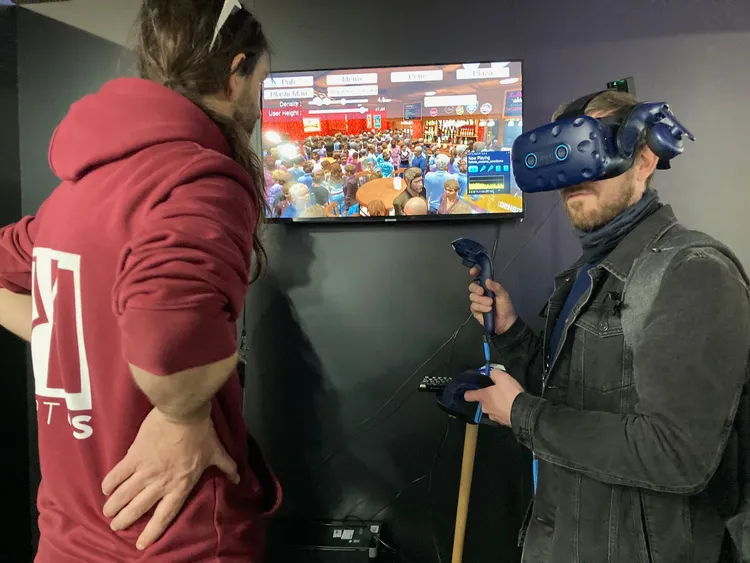
Immerssive crowd research
XR Research Crowd
Research on immersive crowds is an emerging interdisciplinary field that raises numerous fundamental and technical challenges. By intersecting disciplines such as multi-agent simulation, cognitive psychology and immersive technologies, it aims to better understand large-scale social dynamics. Through this brief essay, I propose to outline the main challenges of this research field, along with the approaches explored by the Inria VirtUS team.
Major Challenges in Immersive Crowd Research
One of the primary challenges lies in the inherent complexity of assembling a crowd of human participants for experimental studies. Gathering a sufficient number of individuals while ensuring the repeatability of experiments presents significant logistical constraints. Moreover, learning effects can bias results when the same participant is repeatedly exposed to similar conditions, thus compromising the neutrality of the experimental setup.
From a computational perspective, the complexity lies in optimizing multi-agent simulation, rendering in virtual reality and character animation. Smooth movement, behavioral consistency of avatars, and efficient navigation algorithms are crucial to creating immersive environments that are both believable and scientifically exploitable.
These technical issues are compounded by the specific needs of virtual reality mediums: Environments must offer enough ecological realism to elicit natural behavioral responses from participants. Additionally, interactions with virtual agents must appear believable to maintain immersion and ensure valid data on observed behaviors.
Furthermore, the interdisciplinary nature of this field raises a set of yet unanswered questions ranging from simulation models (How to represent collective behavior?), XR/VR implementation (How to make these simulated worlds believable and interactive?), and crowd psychology (What principles govern human interactions in high-density scenarios?).
Inria VirtUS team
The Inria VirtUS team has made several noteworthy contributions in this domain. One of theses being UMANS (Unified Microscopic Agent Navigation Simulator) a crowd simulation framework which enables rigorous comparison of different local navigation algorithms using a unified model based on optimizing a cost function in velocity space.This abstraction facilitates reproducibility and comparative analysis.
To further support immersive experimentation, the CrowdMP tool was designed. This tool based on top of the UMANS simulation engine ease the setup for VR-based crowd experiments by offering easier control over experimental parameters and seamlessly integrating simulated crowds into research protocols.
These advancements contribute to a richer understanding of crowd behavior, offering a controlled and repeatable environment for experimentation. They also provide a foundation for developing new applications in public safety, urban planning, and interactive robotics.